Beyond Cheongung-II: Korea’s Gulf Defense Opportunity
Dr. Kristian P. Alexander | Former Senior Fellow and Lead Researcher at the Rabdan Security and Defense Institute (RSDI)
Mr. Leonardo Jacopo Maria Mazzucco | Geopolitical Analyst and PhD Candidate at the Catholic University of the Sacred Heart of Milan
As the 2026 U.S.-Iran conflict spilled over throughout the region, several Arab Gulf states faced Iranian missile and drone attacks, while the conflict placed the wider Gulf Cooperation Council (GCC) under heightened aerial and maritime security pressure. Despite high interception rates, Iran’s month-long air campaign has exposed two related problems for the sustainment of Gulf air-defense architecture. First, sustained missile and drone barrages depleted magazine depth, compelling Gulf capitals to replenish stockpiles and expand air defenses rapidly. Traditional Western suppliers, however, have struggled with production bottlenecks.[1] Washington, which remains their anchor security guarantor, has faced its own supply constraints, particularly for Patriot PAC-3 and THAAD (Terminal High Altitude Area Defense) interceptors.[2]Second, swarm and saturation attacks exposed vulnerabilities in the layered air-defense network of the Arab Gulf states. While dedicated systems for upper-, middle-, and lower-altitude defense remain essential, the scale of incoming threats has increasingly stretched individual batteries, underscoring the importance of greater redundancy across and within each defense layer.
These constraints point to three imperatives for Gulf defense planning. First, the Arab Gulf states need surge capacity in layered air defense, with interceptors and sensors available in quantity on short timelines to backfill depleted stocks. Second, they need solutions to protect the coastal and offshore infrastructure, from tankers transiting the Strait of Hormuz to logistics terminals and shipping lanes, from a growing host of threats, including sea mines, unmanned systems, and missiles. Third, Gulf capitals need to prioritize industrial localization and after-sales support over finished-product deliveries alone, giving them greater control over manufacturing, maintenance, and stockpile replenishment timelines.
WHERE KOREA DELIVERS
Korea’s Gulf defense footprint remains uneven. While the UAE and Saudi Arabia have emerged as Seoul’s principal defense partners in the region, Korean engagement with Qatar, Kuwait, Bahrain, and Oman remains considerably more limited, where established U.S. and European suppliers continue to occupy much of the defense market. The UAE and Saudi Arabia therefore provide the clearest indication of how Korea’s defense role in the Gulf could evolve.
The clearest evidence of Korea’s value for these countries is the operational performance of its systems under fire. Two Cheongung-II (M-SAM II) medium-range surface-to-air missile batteries operated by the UAE reportedly achieved a 96 percent interception rate during the early phase of Iran’s missile campaign.[3] The performance prompted both the UAE and Saudi Arabia to seek accelerated deliveries.[4] Abu Dhabi purchased ten M-SAM II batteries in 2022,[5] followed by a similar order from Riyadh in 2024.[6] Seoul appears to have responded, at least for the UAE, with delivery of its third battery reportedly beginning in March 2026.[7] Combat-proven capability, combined with ROK willingness to expedite deliveries, has cemented Korea’s credibility as a responsive supplier at a time when Gulf states face growing demand for interceptors.
Manufactured by a consortium led by LIG Defense and Aerospace (D&A), a Cheongung-II battery comprises four launchers, each carrying eight missiles, alongside a multifunction radar and fire-control systems, for a total loadout of 32 interceptors. Based on hit-to-kill technology, the M-SAM II system provides a middle-layer solution optimized against ballistic missiles at altitudes of approximately 15-20 kilometers.[8]
Beyond performance, three factors strengthen Korea’s appeal to Gulf buyers. First, price and delivery speed. Korean-made systems are generally cheaper than comparable Western alternatives, while offering competitive operational performance.[9] This reflects both scale and depth of the ROK defense-industrial base.[10] Cheongung-II interceptors cost roughly US$1.1 million each, compared with approximately US$3.7 million for a PAC-3 missile.[11] This cost differential is strategically relevant in a high-tempo conflict, such as the one faced by the Gulf capitals, where capable interceptors and sufficient stocks against prolonged saturation attacks are critical. The Cheongung-II, therefore, offers an attractive, combat-proven combination of cost, capability, and replenishment potential.
Second, technology transfer and co-production. The ROK-Egypt K9 howitzer agreement, which includes licensed production and technology transfers,[12] illustrates the industrial model Gulf capitals increasingly seek to replicate, an area where Seoul displays openness to cooperate.[13] Rather than purchasing finished products, Gulf buyers are likely to assess Korean offers against American and European alternatives on their capacity to advance local manufacturing and technology absorption, as part of their broader ambitions to lower long-term dependence on foreign suppliers.
Finally, maintenance and sustainment. Korean defense firms have increasingly built a reputation for follow-through on maintenance, repair, and overhaul (MRO) support,[14] a category in which reliable after-sales support is critical for long-term operational reliability of complex systems. This is particularly relevant for Arab Gulf states, which are expanding their inventories while also seeking to build greater domestic sustainment capacity.[15] For buyers facing decades-long lifecycles, the ability to provide training, spare parts, maintenance, and technical support in a timely fashion may ultimately matter as much as the initial acquisition price. In this respect, Korea’s combination of industrial depth, competitive costs, and willingness to support customers beyond delivery offers a potential advantage in a defense market increasingly defined by sustainment as much as procurement.
WHERE KOREA FALLS SHORT
Against the region’s requirements, however, South Korea shows concrete shortcomings. The ROK defense industry’s strengths come with structural constraints that might collide with Gulf expectations. First, production capacity and capability maturity remain uneven. The Cheongung-II consortium reportedly produces only about eight batteries a year,[16] a rate that could prove insufficient if global demand surges,[17] let alone alongside Korea’s own requirements.[18]For Gulf planners weighing ROK as a hedge against U.S. and European bottlenecks,[19] a second supplier that cannot readily scale offers only a partial solution. Korea’s wider missile-defense portfolio reflects different stages of development. The Hanwha-LIG D&A’s L-SAM, an upper-tier anti-ballistic system comparable to THAAD, entered mass production in 2025,[20] but operational deployment is not expected until 2027. LIG D&A has only recently begun producing flight-test missiles for the KSAM-II, a ship-to-air interceptor intended to replace the U.S.-made SAM-2, with development continuing through 2030.[21] The K-SAAM-Haegung (“Sea Bow”), by contrast, already offers an indigenous short-to-medium-range shipborne air-defense option.[22] Drone-interceptor capabilities, arguably the most urgent requirement given the character of the Iran conflict, remain nascent, with the Defense Acquisition Program Administration (DAPA) launching a program for countering medium-sized suicide drones in May 2026.[23] Gulf capitals keen on diversifying suppliers through the ROK, therefore, need to distinguish between systems that are combat-proven and available today and those whose value rests on expected future capability.
Second, Korean systems increasingly carry a political-entanglement risk. Seoul’s arms-export model was historically premised on separating defense sales from the geopolitical consequences of their use. That separation has become harder to sustain.[24] ROK-made interceptors gained combat validation by shooting down Iranian missiles,[25] indirectly drawing Seoul into a regional conflict it has no independent stake in and limited diplomatic leverage over Tehran. How South Korea navigates this exposure, including retaliation risks against Korean nationals, companies, and shipping, remains an unresolved variable in its relationship with Arab Gulf states.
Third, industrial fragmentation can undermine program execution. Rivalry between HD Hyundai Heavy Industries and Hanwha Ocean delayed the KDDX destroyer program by roughly two years and contributed to Korea’s failure to make Australia’s SEA 300 frigate shortlist, whereas Japanese and German competitors arrived with unified national offers.[26]Canada’s recent submarine contract going to Germany’s TKMS rather than Hanwha reinforced the same pattern.[27]DAPA’s February 2025 “One Team Korea” memorandum, under which HD Hyundai leads surface-combatant exports while Hanwha Ocean focuses on submarines, was intended to address this problem.[28] Hanwha has since brought 11 Korean firms into its Saudi submarine bid,[29] signaling greater coordination is possible. Yet, the two companies continue to compete in third markets,[30] suggesting that export competition remains.
Korea’s longer-term competitiveness will also depend on how seamlessly its systems can integrate with the predominantly U.S.- and European-origin sensors, command networks, and platforms already operated by Gulf militaries. The broader implication is not that Korea is an unreliable supplier, but that its value proposition varies significantly by capability and program. For Gulf buyers, Korean suppliers represent more of a complement to, rather than an automatic substitute for, established Western partners.
THE NAVAL OPENING
The procurement logic and modernization trajectories the Gulf navies call for caution about how far ROK ambitions in the naval market can realistically extend. The market for principal surface combatants is already saturated.[31] Most Gulf capitals have implemented, or recently completed, large-scale acquisitions from leading shipbuilders in the U.S., France, Italy, Spain, and Turkey. These contracts extend platform delivery to include sailor training, maintenance and sustainment, upgrades, and industrial cooperation, cementing broader politico-military relationships.[32] Built over decades, this combination of political trust, operational familiarity, and industrial collaboration gives incumbent suppliers a significant advantage. Arab Gulf states have little incentive to unwind these ties simply to introduce another partner unless the latter can close a clear capability or industrial gap.
Adding a new principal combatant fleet type also entails new training pipelines, logistics and spare-parts chains, maintenance infrastructure, and fleet-integration requirements. For Gulf navies operating fleets composed of multiple foreign-origin platforms, another combatant type can further increase the sustainment burden. These conditions considerably narrow the addressable market for new foreign suppliers. Among the Arab Gulf states, Saudi Arabia has the greatest potential bandwidth for additional principal combatants, particularly if it accelerates the replacement of its four Badr-class corvettes and four Al Madinah-class frigates, in service since the 1980s. The UAE may also seek to replace its aging fleet of fast-attack and patrol crafts, but these requirements are more likely to be addressed through domestic shipbuilding, chiefly the EDGE Group’s Abu Dhabi Ship Building. Saudi Arabia, therefore, represents the most plausible Gulf market for new high-tonnage units in the near term. The key question, however, is not simply whether Riyadh wants new ships, but whether it seeks a new foreign supplier.
A more significant opening could lie in Saudi Arabia's long-standing gap in underwater warfare. Riyadh is reportedly considering submarines, with talks involving Italy’s Fincantieri and South Korea’s Hanwha Ocean.[33] A submarine force would provide covert sea-denial and sea-control capabilities in contested regional waters, adding a stealth layer of defense further afield. However, for a navy with no submarine history, developing an effective underwater force would require substantial investment in specialized training, infrastructure, maintenance, doctrine, and operational culture. These barriers could discourage Riyadh from proceeding, but they also create an opening for a supplier able to offer a comprehensive capability package. For Seoul, therefore, the more promising naval opportunity may not be competing head-on for another surface-combatant sale, but addressing capability gaps where Gulf navies have yet to establish comparable procurement and industrial relationships. For Gulf capitals, this would reduce the costs of introducing a new supplier while giving them greater diversification vis-à-vis conventional providers.
Besides submarines, the ROK may have a comparative advantage in the mission set the Iran conflict has highlighted as both underdeveloped and increasingly strategic: distributed, uncrewed defense of shipping lanes and fixed energy infrastructure against sea mines, drones, and missiles. This gap is one most Gulf navies are still trying to close through a diversified network of suppliers and industrial partners.[34] Korean companies, including LIG D&A,[35] Hanwha Systems,[36] and HD HHI,[37] are advancing unmanned systems and AI-enabled technologies for maritime security missions, including ISR, mine-hunting, and close-range protection. LIG D&A and Hanwha have also established cooperation with the U.S. company Anduril,[38] which has recently expanded its ties with the Emirati defense giant EDGE.[39] This overlap could provide a useful basis for ROK-UAE industrial cooperation, allowing Seoul to plug into defense-industrial networks that Abu Dhabi is already developing rather than establishing entirely new ones.
While a saturated surface-combatant market limits the ROK’s ability to displace entrenched suppliers, Seoul could instead carve out a niche in the still-developing market for unmanned and AI-enabled maritime capabilities, offering Arab Gulf states systems and co-development options tailored to the swarm and saturation-attack environment demonstrated by the Iran conflict.
FROM AIR DEFENSE TO MARITIME SECURITY
For Gulf security going forward, surface combatants and missile defense should be understood as complementary responses to the same threat environment, rather than substitutes. This is particularly important for the smaller Arab Gulf states, whose limited territorial depth leaves little margin to absorb aerial threats and makes ship-based interception a critical additional layer of air defense.
Layered missile defense, where Korea has already proved itself, remains critical against saturation attacks. For the Gulf states, therefore, closing air-defense capacity gaps against swarm tactics and replenishing interceptor stockpiles remain the most urgent near-term priorities. Whether growing interest in Korean-made systems translates into procurement contracts will ultimately rest on Seoul’s capacity to close this gap by scaling up Cheongung- II production and accelerating L-SAM development. Naval capabilities provide an indispensable complementary defense layer. Despite retaining blue-water ambitions, Gulf navies will remain focused on sea control and protection close to home waters, providing an additional air defense layer through ship-based interceptors. As the market for principal surface combatants is already saturated, capacity to absorb new Korean offerings is marginal. New contracts are likely to emerge only where ROK companies can offer a clear capability, commercial, and localization advantage over entrenched suppliers.
FROM PROCUREMENT TO PRODUCTION
Beyond procurement, local manufacturing offers another route to facilitate adequate interceptor inventories and rapid replenishment. This option, however, is viable only where the domestic defense-industrial base is sufficiently mature to absorb technology and sustain complex production. The UAE is further along this path, with cooperation with South Korea increasingly moving beyond procurement toward local production and sustainment.
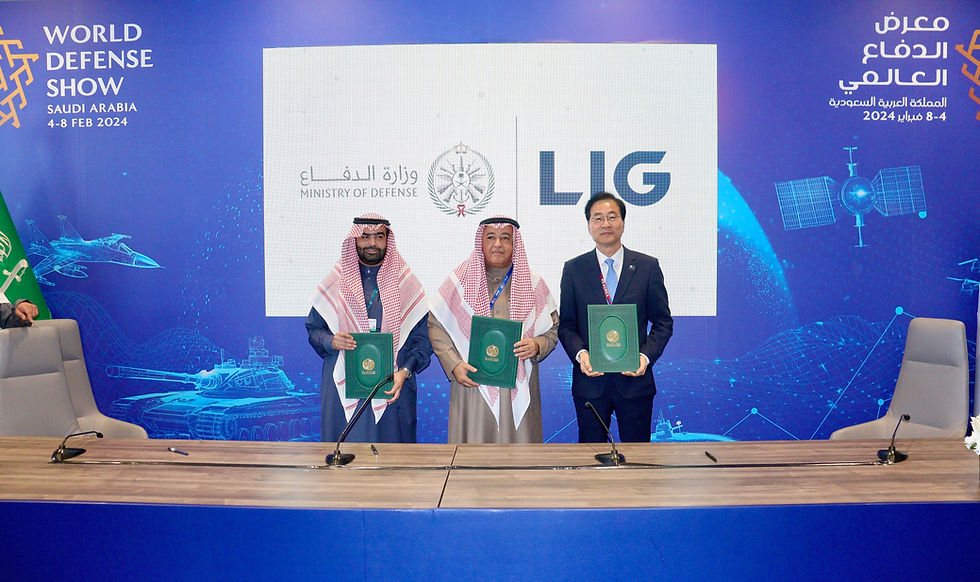
The foundations were laid in November 2025, when the Emirati defense company Calidus and LIG D&A agreed to establish a joint venture to manufacture missiles in the UAE.[40] Although the missile to be produced has not been specified, the venture is likely to focus on Cheongung-II interceptors alongside the co-development of new air-defense solutions. This was followed in February 2026 by an MOU between EDGE and DAPA establishing a framework for design-to-production cooperation.[41] In May, the Tawazun Council for Defense Enablement, the Emirati authority responsible for defense industrial development, and LIG D&A expanded this relationship further by agreeing to establish a UAE-based global defense manufacturing hub.[42]
Together, these initiatives could give the UAE both greater access to Korean technology and a growing role in manufacturing, sustaining, and eventually developing Korean-origin systems locally. Cooperation is also expanding into emerging capabilities. LIG D&A and U.S. AI company Palantir have agreed to develop integrated air-defense and unmanned-system solutions for the UAE,[43] creating potential complementarities for Korean-Emirati industrial cooperation. Saudi Arabia has likewise reportedly discussed local production of Korean systems with LIG D&A,[44]although talks over the K-LOGIR (“Poniard”) surface-to-ship guided rocket remain considerably narrower in scope. The UAE, therefore, provides the clearest test of whether Korean defense cooperation can evolve from selling systems to strengthening local production and sustainment capacity.
Notes
[1] The Economist, “What happens when the West runs out of interceptor missiles,” August 18, 2026, https://www.economist.com/international/2026/08/18/what-happens-when-the-west-runs-out-of-interceptor-missiles.
[2] Natalie Oliverio, “Iran war depleted US Patriot missile stockpiles, creating readiness challenges, experts say,” Defense News, July 30, 2026, https://www.defensenews.com/news/your-military/2026/07/30/iran-war-depleted-us-patriot-missile-stockpiles-creating-readiness-challenges-experts-say/.
[3] Park Ung, “UAE seeks faster delivery of Korean air defense system after reported 96% hit rate,” The Korea Times, March 6, 2026, https://www.koreatimes.co.kr/southkorea/defense/20260306/ uae-seeks-faster-delivery-of-korean-air-defense-system-after-reported-96-hit-rate.
[4] Jung A-im, “Saudi, UAE Urge Faster M-SAM Deliveries from South Korea,” The Chosun Daily, April 13, 2026, https://www.chosun.com/english/world-en/2026/04/13/KWUCIXCNK5CTPDE5S56AQFJG2E/.
[5] Brian Kim, “South Korea inks largest arms export deal with UAE for missile interceptor,” Defense News, January 18, 2022, https://www.defensenews.com/industry/2022/01/18/south-korea-inks-largest-arms-export-deal-with-uae-for-missile-interceptor/.
[6] Korea JoongAng Daily, “Saudi Arabia buys Korea's Cheongung-II missiles for $3.2 billion,” February 6, 2024, https://www.koreajoongangdaily.com/korea/saudi-arabia-buys-koreas-cheongung-ii-missiles-for-32-billion/11620629.
[7] Kim Seung-yeon, “UAE sends military planes to S. Korea to transport Cheongung missile systems,” Yonhap News Agency, June 12, 2026, https://en.yna.co.kr/view/AEN20260612009100315.
[8] Gabriel Dominguez and Dae Young Kim, “RoKAF receives first Cheongung-II M-SAM battery,” Janes, November 26, 2020, https://www.janes.com/defence-intelligence-insights/defence-news/rokaf-receives-first-cheongung-ii-m-sam-battery.
[9] Lami Kim, “Mind the air-defence gap: South Korea’s burgeoning role in air and missile defence,” IISS, March 27, 2026, https://www.iiss.org/online-analysis/military-balance/2026/03/mind-the-air-defence-gap-south-koreas-burgeoning-role-in-air-and-missile-defence/.
[10] Wooyeal Paik, “South Korea’s Emergence as a Defense Industrial Powerhouse,” French Institute of International Relations, No. 139, February 2024, https://www.ifri.org/en/papers/south-koreas-emergence-defense-industrial-powerhouse. Chung Min Lee, “South Korea as a Rising Defence Exporter: Challenges and Opportunities,” IISS, December 11, 2025, https://www.iiss.org/research-paper/2025/12/south-korea-as-a-rising-defence-exporter-challenges-and-opportunities/.
[11] Lee Yoon-jung, “Cheongung-II fuels global demand as countries seek Patriot alternative,” Chosun Biz, May 18, 2026, https://biz.chosun.com/en/en-industry/2026/05/18/VEOYRJE2WFGKPNDATBM45H35X I/.
[12] Hanwha Aerospace, “Hanwha Defense signs contract with Egypt for K9 artillery solution,” February 3, 2022, https://www.hanwhaaerospace.com/eng/media/newsroom/vie w.do?seq=277.
[13] Ju Hyung Kim, “South Korea and the Middle East’s Defense Localization Drive: A New Strategic Fit,” The Washington Institute for Near East Policy, October 30, 2025, https://www.washingtoninstitute.org/policy-analysis/south-korea-and-middle-easts-defense-localization-drive-new-strategic-fit.
[14] Park Sung-woo, “Korean defense firms target MRO market to boost long-term revenues and competitiveness,” Chosun Biz, June 16, 2025, https://biz.chosun.com/en/en-industry/2025/06/16/FQ7OVGDKI5CNZHVNZ44B4I5J3E/
[15] Albert Vidal Ribe, “Challenge for the Gulf states: rearming after the war,” IISS, May 12, 2026, https://www.iiss.org/online-analysis/online-analysis/2026/05/challenge-for-the-gulf-states-rearming-after-the-war/.
[16] The Korea Times, “South Korea faces export-readiness trade-off amid Gulf defense push,” April 29, 2026, https://www.koreatimes.co.kr/southkorea/defense/20260429/s outh-korea-faces-export-readiness-trade-off-amid-gulf-defense-push.
[17] Bahk Eun-ji, “Rising defense exports test supply chain resilience,” The Korea Times, July 24, 2026, https://www.koreatimes.co.kr/southkorea/defense/20260724/ defense-export-boom-tests-supply-chain-resilience.
[18] Kim Ji-hwan, “South Korea deploys Cheongung II to bolster layered missile defense,” Chosun Biz, August 3, 2026, https://biz.chosun.com/en/en-policy/2026/08/03/HUKHAGH6PNESHEWEBQI3JELOPI/.
[19] Francesco Salesio Schiavi, “Beyond the U.S. Umbrella: Gulf States and the Diversification of Air Defense After Iran,” Arab Gulf States Institute, April 28, 2026, https://agsi.org/analysis/beyond-the-u-s-umbrella-gulf-states-and-the-diversification-of-air-defense-after-iran/.
[20] Hanwha Aerospace, “Hanwha Aerospace awarded L-SAM contract to bolster Korea’s long-range air and missile defense,” November 28, 2025, https://www.hanwhaaerospace.com/eng/media/newsroom/vie w.do?seq=587.
[21] Eunhyuk Cha, “LIG D&A Begins Assembly of Prototype KSAM-II Missiles for ROK Navy,” Naval News, July 27, 2026, https://www.navalnews.com/naval-news/2026/07/lig-da-begins-assembly-prototype-ksam-ii-missile-rok-navy/.
[22] K Defense News, “K-SAAM 'Haegung' Breaks Into Global Naval Air Defense Market,” April 26, 2026, https://kdefensenews.com/m/view.php?idx=1184&mcode=.
[23] Kim Hyun-soo, “DAPA launches project to develop hard-kill interceptor drones to counter ‘suicide drones’,” Yonhap News Agency, May 22, 2026, https://en.yna.co.kr/view/AEN20260522002700315.
[24] Nima Khorrami, “South Korea’s Arms Exports Are Now Involved in the Iran War,” The Diplomat, March 19, 2026, https://thediplomat.com/2026/03/south-koreas-arms-exports-are-now-involved-in-the-iran-war/.
[25] Park Ung, “Korean air defense system in UAE downs Iranian missile,” The Korea Times, March 4, 2026, https://www.koreatimes.co.kr/southkorea/defense/20260304/k orean-air-defense-system-in-uae-downs-iranian-missile.
[26] Kim Hyun-bin, “Rivalry between Korean shipbuilders at center of delayed next-gen destroyer project,” The Korea Times, April 16, 2025, https://www.koreatimes.co.kr/southkorea/defense/20250416/r ivalry-between-korean-shipbuilders-at-center-of-delayed-next-gen-destroyer-project. Park Jae-hyuk, “Fears grow over shipbuilding rivalry disrupting naval vessel exports,” The Korea Times, November 12, 2024, https://www.koreatimes.co.kr/business/companies/20241112/fears-grow-over-shipbuilding-rivalry-disrupting-naval-vessel-exports.
[27] Kim Min-Young, “Korea loses Canadian submarine bid to Germany's TKMS,” Korea JoongAng Daily, July 7, 2026, https://www.koreajoongangdaily.com/business/korea-loses-canadian-submarine-bid-to-germanys-tkms/12758000.
[28] Naval News, “Korean Shipbuilding Giants Join Forces in Naval Export Market,” February 25, 2025, https://www.navalnews.com/naval-news/2025/02/korean-shipbuilding-giants-join-forces-in-naval-export-market/.
[29] Naval Today, “Hanwha Ocean links up with South Korean firms to pursue submarine projects in Middle East,” February 10, 2026, https://www.navaltoday.com/2026/02/10/hanwha-ocean-links-up-with-south-korean-firms-to-pursue-submarine-projects-in-middle-east.
[30] Kim Nam-hee, “Korean shipbuilders vie for Thai frigate deal, eye Southeast Asia gains,” Chosun Biz, June 26, 2026, https://biz.chosun.com/en/en-industry/2026/06/26/3O6635YARJGPHBHNQ6TJWML7BI /.
[31] Kévin Thievon, “New Ambitions at Sea: Naval Modernisation in the Gulf States,” IISS, June 5, 2023, https://www.iiss.org/research-paper/2023/06/new-ambitions-at-sea-naval-modernisation-in-the-gulf-states/.
[32] Leonardo Jacopo Maria Mazzucco, “Targeted Acquisitions, Major Commissions: The UAE’s Dual Approach to the Naval Defense Sector,” Arab Gulf States Institute, April 27, 2023, https://agsi.org/analysis/targeted-acquisitions-major-commissions-the-uaes-dual-approach-to-the-naval-defense-sector/. Albert Vidal, Ribe, “Qatar Embarks on Major Naval Expansion,” Arab Gulf States Institute, August 8, 2023, https://agsi.org/analysis/qatar-embarks-on-major-naval-expansion/. Leonardo Jacopo Maria Mazzucco, “Kuwait’s Naval Modernization Push,” Arab Gulf States Institute, August 27, 2025, https://agsi.org/analysis/kuwaits-naval-modernization-push/. Albert Vidal Ribe, “Shopping for Sea Power: Saudi Arabia’s Naval Transformation,” ISPI, October 3, 2025, https://www.ispionline.it/en/publication/shopping-for-sea-power-saudi-arabias-naval-transformation-217520.
[33] Korean JoongAng Daily, “Korean shipbuilders to square off next in Saudi Arabia, Thailand and Greece,” July 24, 2026, https://www.koreajoongangdaily.com/business/korean-shipbuilders-to-square-off-next-in-saudi-arabia-thailand-and-greece/12787858.
[34] Sascha Bruchmann and Albert Vidal Ribe, “The Gulf Cooperation Council states’ uninhabited and autonomous capabilities,” IISS, November 28, 2024, https://www.iiss.org/online-analysis/online-analysis/2024/11/the-gulf-cooperation-council-states-uninhabited-and-autonomous-capabilities/.
[35] “Maritime Warfare,” LIG D&A, accessed August 20, 2026, https://www.ligdefenseaerospace.com/eng/business/oceanList. do.
[36] “Unmanned Maritime System,” Hanwha Systems, accessed August 20, 2026, https://www.hanwhasystems.com/en/business/defense/naval/ marine_index.do.
[37] HD, “Unmanned Vessels Cutting Through the Seas: Where Do We Stand?,” February 25, 2025, https://www.hd.com/en/newsroom/media-hub/press/view?detailsKey=3444.
[38] Anduril, “Scaling Autonomous Surface Vessels with the World’s Best Ship Builders for US Navy,” April 20, 2026, https://www.anduril.com/news/scaling-autonomous-surface-vessels-with-the-world-s-best-ship-builders-for-us-navy.
[39] Anduril, “EDGE Group and Anduril to Form UAE-US Joint Venture to Develop Autonomous Systems,” November 13, 2025, https://www.anduril.com/news/edge-group-and-anduril-to-form-uae-us-joint-venture-to-develop-autonomous-systems.
[40] WAM, “Calidus, LIG Nex1 sign strategic partnership to manufacture missiles in UAE,” November 23, 2025, https://www.wam.ae/en/article/bmv1ypq-calidus-lig-nex1-sign-strategic-partnership.
[41] EDGE, “EDGE and Republic of Korea's DAPA Advance Major Defence Cooperation,” February 27, 2026, https://edgegroup.ae/news/edge-and-republic-koreas-dapa-advance-major-defence-cooperation.
[42] WAM, “Tawazun, Korean LIG D&A sign MoU to establish global defence manufacturing hub in UAE,” May 5, 2026, https://www.wam.ae/en/article/c025vmo-%60tawazun-korean-lig-da-sign-mou-establish-global.
[43] LIG D&A, “LIG Nex1 and Palantir sign MOU for collaboration on the development of an integrated air defense network and unmanned system solutions,” March 25, 2026, https://www.ligdefenseaerospace.com/eng/news/nex1newsNe wView.do?bbs_no=7360.
[44] Jérôme Brahy, “Saudi Arabia discusses local production of Poniard guided rockets with South Korea.” Army Recognition Group, January 12, 2026, https://www.armyrecognition.com/news/army-news/2026/saudi-arabia-discusses-local-production-of-poniard-guided-rockets-with-south-korea.
About the Authors

Dr. Kristian P. Alexander
Former Senior Fellow and Lead Researcher at the Rabdan Security and Defense Institute (RSDI)
Dr. Kristian P. Alexander is a gulf security and foreign-policy analyst based in the UAE. Until recently, he served as Senior Fellow and Lead Researcher at the Rabdan Security and Defense Institute (RSDI), Abu Dhabi, UAE, and as an advisor at Gulf States Analytics, a Washington-based geopolitical risk consultancy. He previously worked as a Senior Fellow at Trends Research and Advisory in Abu Dhabi and was an Assistant Professor at the College of Humanities and Social Sciences at Zayed University in Abu Dhabi.

Mr. Leonardo Jacopo Maria Mazzucco
Geopolitical Analyst and PhD Candidate at the Catholic University of the Sacred Heart of Milan
Mr. Leonardo Jacopo Maria Mazzucco is a geopolitical analyst and PhD Candidate at the Catholic University of the Sacred Heart of Milan, Italy, and a researcher who focuses on the security affairs of the Gulf region. He is also an analyst at Gulf State Analytics (GSA), a Washington-based geopolitical risk consultancy. He has an MA degree in Comparative and International Relations from Ca’ Foscari University of Venice and an MA degree in Middle Eastern Studies from the Graduate School of Economics and International Relations (ASERI) at Catholic University of the Sacred Heart in Milan, Italy.


